
How Global Capital is Diversifying Geopolitical Risk

I notice discussions around global Foreign Direct Investment (FDI) increasingly focus on one question: which country is replacing China? My reading is that this misses what is happening.
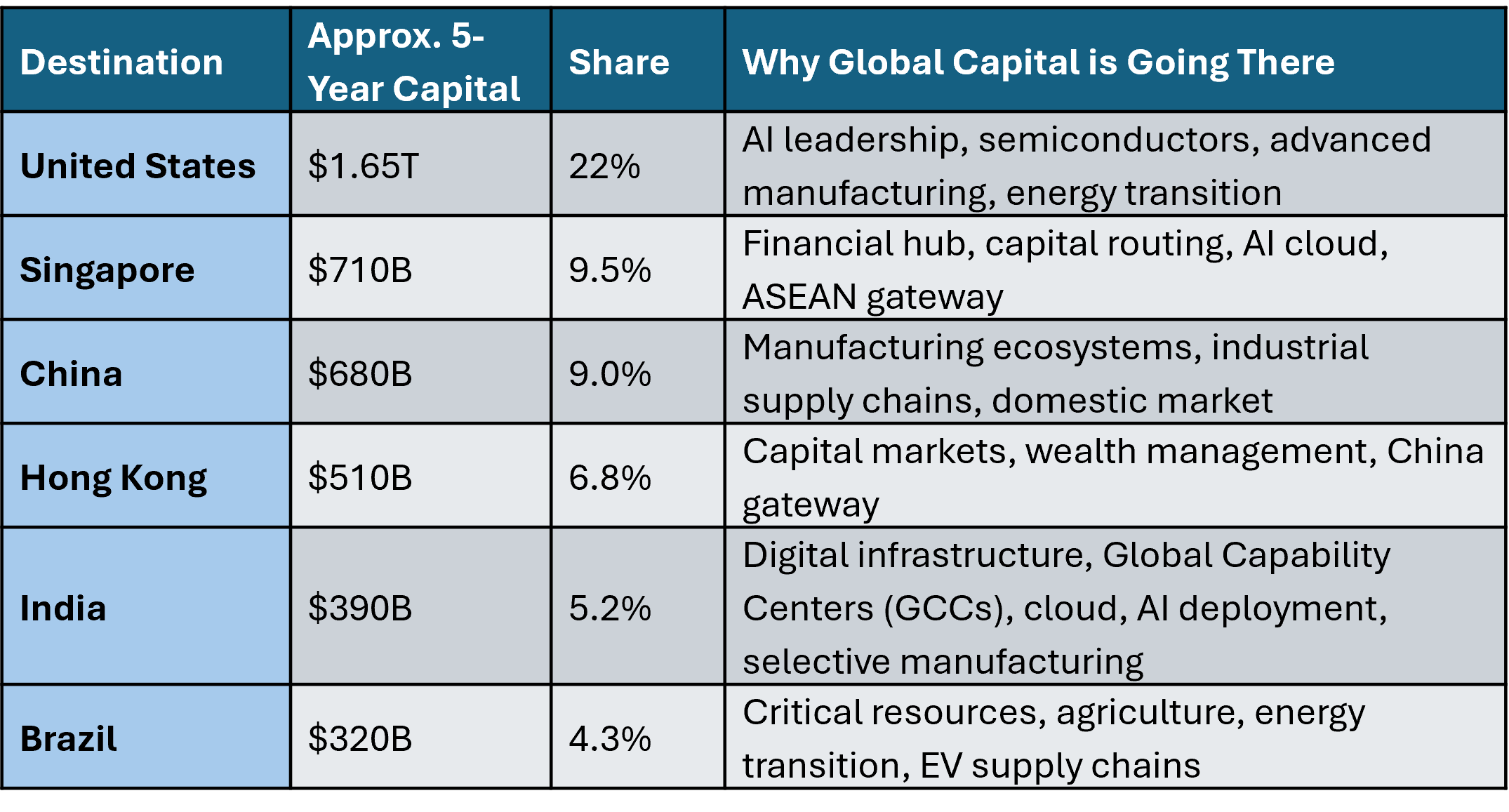
Approximate gross inflows and committed corporate investment (2021–2026). Figures compiled from UNCTAD, DPIIT and major corporate announcements.
The world is not replacing one manufacturing hub with another. It is reorganizing itself into specialized centers, with each country leveraging its own strengths and ecosystem. Global capital is no longer looking for one destination. Instead, it is spreading investment across countries that each bring something different to the global economy.
This helps explain the pattern we have seen over the past five years. The United States continues to attract investment into semiconductors, AI infrastructure and advanced manufacturing because these are now as much about national security as they are about economic competitiveness.
China remains central because no country has yet replicated its manufacturing ecosystem, supplier networks or industrial scale. Singapore and Hong Kong continue to play a critical role as Asia’s financial hubs, connecting global capital with regional markets.
Brazil is attracting investment because of its importance to the energy transition; agriculture and the critical resources needed for future supply chains.
India has emerged in a different category, attracting investment into digital infrastructure, cloud computing, Global Capability Centres (GCCs) and increasingly electronics manufacturing. Each destination is becoming important for a different reason rather than competing for the same investment.
AI is accelerating this shift. Unlike previous technology cycles, AI is not simply about software. It requires semiconductors, cloud infrastructure, data centers, reliable power, digital identity, payment systems and large-scale user interaction. Countries that can provide these ecosystems are becoming strategically more valuable than those that simply offer lower labor costs. Companies are not reducing investment. They are changing where they invest and why.
One small example of this broader trend is Meta’s appointment of Kunal Shah to lead WhatsApp globally. Meta is not short of engineering talent. Rather, it reflects the growing importance of understanding digital ecosystems at scale. In India, WhatsApp extends well beyond messaging into commerce, payments, customer engagement and public services. That ecosystem may become increasingly valuable as AI shifts from being a search tool to becoming a conversational interface for commerce and services.
Looking ahead…
Globalization is not ending but it is evolving. The geopolitical question is no longer which country replaces another. It is which countries become indispensable to the global economy. AI is likely to accelerate this shift, favoring countries that combine strategic importance with the infrastructure needed to support the next generation of industries.
This post builds on an earlier one about where power concentrates in the AI ecosystem. Here, I look at how global capital is responding. My next post will examine what this means for geopolitics.